ABM Constructor: различия между версиями
Материал из Поле цифровой дидактики
Patarakin (обсуждение | вклад) Нет описания правки |
Patarakin (обсуждение | вклад) Нет описания правки |
||
| Строка 17: | Строка 17: | ||
}} | }} | ||
* https://www.youtube.com/watch?v=PGwaRCW1-fo | * https://www.youtube.com/watch?v=PGwaRCW1-fo | ||
* https://vk.com/video-21242193_456239664?list=ln-bG0pEeZQ1cQCDZAnYQ - ВКонтакте | |||
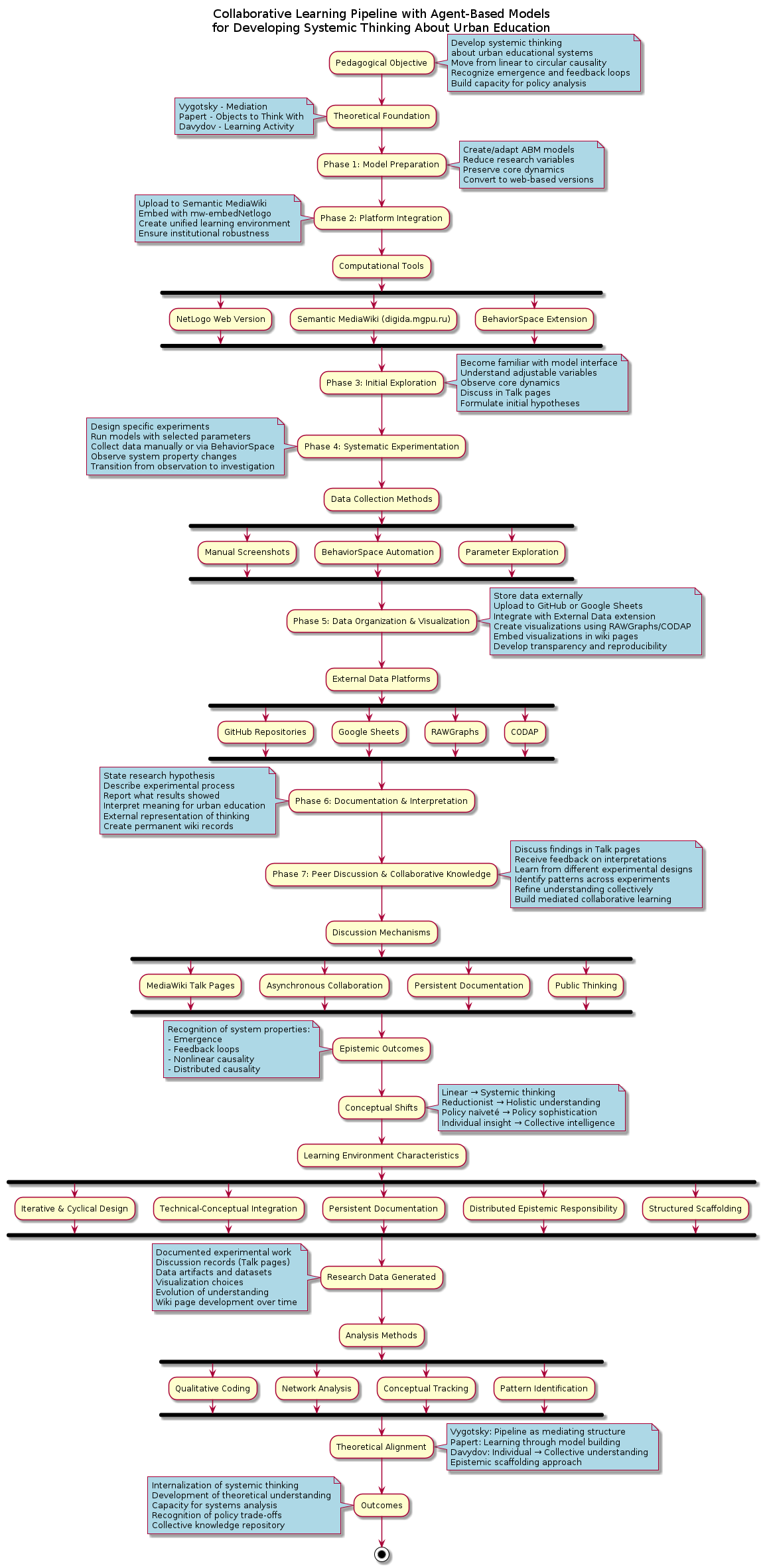
<uml> | |||
@startuml | |||
skinparam NoteBackgroundColor lightblue | |||
title Collaborative Learning Pipeline with Agent-Based Models\nfor Developing Systemic Thinking About Urban Education | |||
:Pedagogical Objective; | |||
note right | |||
Develop systemic thinking | |||
about urban educational systems | |||
Move from linear to circular causality | |||
Recognize emergence and feedback loops | |||
Build capacity for policy analysis | |||
end note | |||
:Theoretical Foundation; | |||
note left | |||
Vygotsky - Mediation | |||
Papert - Objects to Think With | |||
Davydov - Learning Activity | |||
end note | |||
:Phase 1: Model Preparation; | |||
note right | |||
Create/adapt ABM models | |||
Reduce research variables | |||
Preserve core dynamics | |||
Convert to web-based versions | |||
end note | |||
:Phase 2: Platform Integration; | |||
note left | |||
Upload to Semantic MediaWiki | |||
Embed with mw-embedNetlogo | |||
Create unified learning environment | |||
Ensure institutional robustness | |||
end note | |||
:Computational Tools; | |||
fork | |||
:NetLogo Web Version; | |||
fork again | |||
:Semantic MediaWiki (digida.mgpu.ru); | |||
fork again | |||
:BehaviorSpace Extension; | |||
end fork | |||
:Phase 3: Initial Exploration; | |||
note right | |||
Become familiar with model interface | |||
Understand adjustable variables | |||
Observe core dynamics | |||
Discuss in Talk pages | |||
Formulate initial hypotheses | |||
end note | |||
:Phase 4: Systematic Experimentation; | |||
note left | |||
Design specific experiments | |||
Run models with selected parameters | |||
Collect data manually or via BehaviorSpace | |||
Observe system property changes | |||
Transition from observation to investigation | |||
end note | |||
:Data Collection Methods; | |||
fork | |||
:Manual Screenshots; | |||
fork again | |||
:BehaviorSpace Automation; | |||
fork again | |||
:Parameter Exploration; | |||
end fork | |||
:Phase 5: Data Organization & Visualization; | |||
note right | |||
Store data externally | |||
Upload to GitHub or Google Sheets | |||
Integrate with External Data extension | |||
Create visualizations using RAWGraphs/CODAP | |||
Embed visualizations in wiki pages | |||
Develop transparency and reproducibility | |||
end note | |||
:External Data Platforms; | |||
fork | |||
:GitHub Repositories; | |||
fork again | |||
:Google Sheets; | |||
fork again | |||
:RAWGraphs; | |||
fork again | |||
:CODAP; | |||
end fork | |||
:Phase 6: Documentation & Interpretation; | |||
note left | |||
State research hypothesis | |||
Describe experimental process | |||
Report what results showed | |||
Interpret meaning for urban education | |||
External representation of thinking | |||
Create permanent wiki records | |||
end note | |||
:Phase 7: Peer Discussion & Collaborative Knowledge; | |||
note right | |||
Discuss findings in Talk pages | |||
Receive feedback on interpretations | |||
Learn from different experimental designs | |||
Identify patterns across experiments | |||
Refine understanding collectively | |||
Build mediated collaborative learning | |||
end note | |||
:Discussion Mechanisms; | |||
fork | |||
:MediaWiki Talk Pages; | |||
fork again | |||
:Asynchronous Collaboration; | |||
fork again | |||
:Persistent Documentation; | |||
fork again | |||
:Public Thinking; | |||
end fork | |||
:Epistemic Outcomes; | |||
note left | |||
Recognition of system properties: | |||
- Emergence | |||
- Feedback loops | |||
- Nonlinear causality | |||
- Distributed causality | |||
end note | |||
:Conceptual Shifts; | |||
note right | |||
Linear → Systemic thinking | |||
Reductionist → Holistic understanding | |||
Policy naïveté → Policy sophistication | |||
Individual insight → Collective intelligence | |||
end note | |||
:Learning Environment Characteristics; | |||
fork | |||
:Iterative & Cyclical Design; | |||
fork again | |||
:Technical-Conceptual Integration; | |||
fork again | |||
:Persistent Documentation; | |||
fork again | |||
:Distributed Epistemic Responsibility; | |||
fork again | |||
:Structured Scaffolding; | |||
end fork | |||
:Research Data Generated; | |||
note left | |||
Documented experimental work | |||
Discussion records (Talk pages) | |||
Data artifacts and datasets | |||
Visualization choices | |||
Evolution of understanding | |||
Wiki page development over time | |||
end note | |||
:Analysis Methods; | |||
fork | |||
:Qualitative Coding; | |||
fork again | |||
:Network Analysis; | |||
fork again | |||
:Conceptual Tracking; | |||
fork again | |||
:Pattern Identification; | |||
end fork | |||
:Theoretical Alignment; | |||
note right | |||
Vygotsky: Pipeline as mediating structure | |||
Papert: Learning through model building | |||
Davydov: Individual → Collective understanding | |||
Epistemic scaffolding approach | |||
end note | |||
:Outcomes; | |||
note left | |||
Internalization of systemic thinking | |||
Development of theoretical understanding | |||
Capacity for systems analysis | |||
Recognition of policy trade-offs | |||
Collective knowledge repository | |||
end note | |||
stop | |||
@enduml | |||
</uml> | |||
Версия от 13:06, 2 января 2026
| Краткое описание инструмента | Конструктор использования многоагентого моделирования - позволяет конструировать структуру учебных курсов из готовых блоков и включать в состав материалов многоагентные модели для экспериментов и дальнейшей модификации. |
|---|---|
| Возможности | Конструктор используется возможности Semantic MediaWiki и языков агентного моделирования, что позволяет собирать учебные материалы на страницах курса, используя стандартный язык запросов SMW ask и языки блочного и текстового программирования - NetLogo, Snap! |
| Трудности использования | Необходимо на базовом уровне знать язык запросов ask и принципы агентного моделирования |
| Область знаний | NetSci, Педагогика, Психология, Образование, Интернет вещей, Большие данные, Моделирование |
| Область применения | образование |
| Поясняющее видео | https://vk.com/video-21242193 456239664?list=ln-bG0pEeZQ1cQCDZAnYQ |
| Веб-сайт | http://digida.mgpu.ru/index.php?title=ABM Constructor |
| Пользователи | Учащиеся, Преподаватели, Исследователи |
| Используется для создания (проведения) | генерация контента |
| Разработчик | Moscow City University |
| Сообщество вокруг средства | |
| Лицензия | Открытая |
| Год первого релиза | 2024 |
| Совместное сетевое использование | Да |
| Какой язык основной | Russian |
| Есть ли поддержка Искусственным Интеллектом | Да |
- https://www.youtube.com/watch?v=PGwaRCW1-fo
- https://vk.com/video-21242193_456239664?list=ln-bG0pEeZQ1cQCDZAnYQ - ВКонтакте