Треугольник Энгестрёма: различия между версиями
Материал из Поле цифровой дидактики
Patarakin (обсуждение | вклад) |
Patarakin (обсуждение | вклад) |
||
| Строка 111: | Строка 111: | ||
Object --> Outcome : Transformed into | Object --> Outcome : Transformed into | ||
Instruments --> Object : Mediates | |||
Community --> Object : Shares | |||
Community --> Rules : Follows | |||
Community --> Division_of_Labor : Participates in | |||
Rules --> Teacher : Constrain | |||
Rules --> Student : Constrain | |||
Rules --> Community : Coordinate | |||
Division_of_Labor --> Teacher : Assigns roles | |||
Division_of_Labor --> Student : Assigns roles | |||
Division_of_Labor --> Community : Organizes | |||
@enduml | |||
</uml> | |||
== V 2 == | |||
<uml> | |||
@startuml | |||
left to right direction | |||
class Teacher { | |||
Individual or group | |||
} | |||
class Student { | |||
Individual or group | |||
} | |||
class Object { | |||
Raw material transformed | |||
into outcomes | |||
} | |||
class Instruments { | |||
Tools and signs | |||
} | |||
class Community { | |||
Multiple individuals/groups | |||
} | |||
class Rules { | |||
Explicit and implicit | |||
} | |||
class Division_of_Labor { | |||
Horizontal and vertical | |||
} | |||
class Output { | |||
Joint outcome | |||
} | |||
Teacher --> Object : Transforms | |||
Teacher --> Instruments : Mediates | |||
Teacher --> Community : Belongs to | |||
Teacher --> Output : Contributes to | |||
Student --> Object : Transforms | |||
Student --> Instruments : Mediates | |||
Student --> Community : Belongs to | |||
Student --> Output : Contributes to | |||
Object --> Output : Transformed into | |||
Instruments --> Object : Mediates | Instruments --> Object : Mediates | ||
Community --> Object : Shares | Community --> Object : Shares | ||
Версия от 13:26, 22 мая 2024
| Описание | Визуальное представление отношений между различными составляющими теории деятельности |
|---|---|
| Область знаний | Социология, Образование |
| Авторы | Энгестрём |
| Поясняющее видео | |
| Близкие понятия | Диаграмма деятельности, Деятельность |
| Среды и средства для освоения понятия |

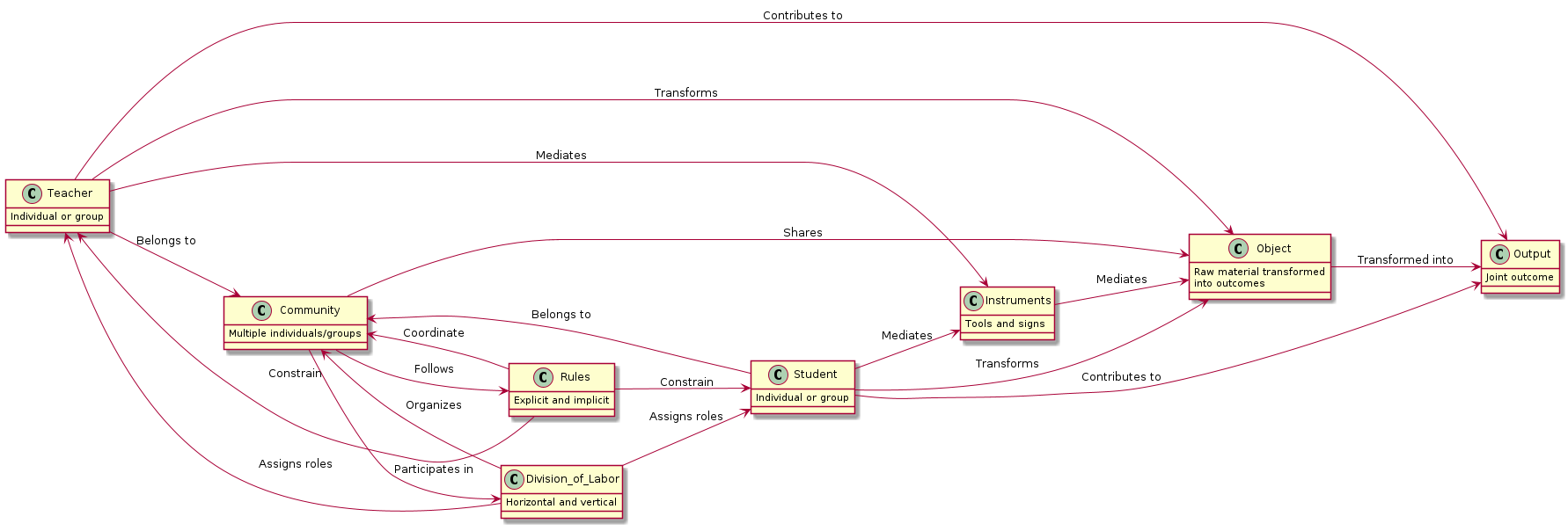
This diagram represents the structure of an activity system according to Engeström's framework. The key components are:
- Subject: The individual or group engaged in the activity
- Object: The raw material that is transformed into outcomes
- Instruments: The tools and signs that mediate the activity
- Community: The multiple individuals and groups involved
- Rules: The explicit and implicit regulations that constrain actions
- Division of Labor: The horizontal and vertical division of tasks and roles
Another variant

V 2